
Corporate coffee

Tim Hortons coffee and the environment

If you are Canadian or live in a U.S. border state, you know Tim Hortons. This coffee and donut/fast food shop completely dominates the carry-out coffee market in Canada, with over 2,700 locations serving around 3 million cups of coffee a day, leaving Starbucks a distant second. Tim Hortons is such a Canadian cultural icon that there is even a store in Kandahar, Afghanistan, serving Canadian troops. There are also 345 stores in the U.S. with a goal of 500 by the end of 2008. Tim Hortons was acquired by Wendy’s International in 1995, but divested and spun it off late in 2006, so Tim Hortons is once again an independent company.

Is Tim Hortons coffee sustainable?

The coffee
The one-sentence summary is this: Tim Hortons does not sell organic coffee, does not sell Fair Trade coffee, and does not disclose the source of its green beans.

On their web site, the company explains, “we decided against buying fair trade coffee” and instead developed a program that works directly with the growers. This program, initiated in 2005, is called the Sustainable Coffee Partnership, and is implemented and managed by the outside organization EDE Consulting, of the Neumann Kaffee Gruppe, Hamburg, Germany. The Partnership will focus on three-year projects. These will provide technical assistance and investment in infrastructure to improve productivity and quality, aid in crop diversification (such as bananas), address the needs of families, and emphasize  “the need to respect and
protect the environment.”

The 2006 Tim Hortons annual report notes that part of the purpose of the Sustainable Coffee Partnership is to “fight against poverty among the people who provide one of the Company’s most important products, and to play a meaningful role in providing for the future supply of quality green coffee.” Therefore, the sites of the projects presumably give an indication of where Tim Hortons sources some its coffee. The first project was in Guatemala, with 750 producers in the communities of Zacapa, Chiquimula and Jutiapa near the Honduran border. Other projects are with 200 producers in Colombia in northern Huila, and in Brazil.

Colombia and Brazil are two of the biggest producers of technified “sun” coffee in the world, but there is no information on how much coffee they source from which countries or how it is grown. Their annual report merely says they have “many suppliers and alternate suppliers for coffee.”

Waste

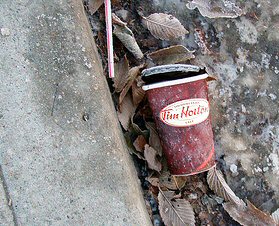
I found that one couldn’t research Tim Hortons without coming across a lot of material on the ubiquity of disposable Tim Hortons coffee cups. They evidently paper Canada. An article in Macleans quoted a Sierra Club representative who said, “The Tim Hortons cup is easily the No. 1 recognizable item of litter in the country.” One often-cited statistic is that 22% of the litter in the province of Nova Scotia was from Tim Hortons.

Of course, it’s not really the company’s fault if people don’t properly dispose of their, and the company has started some anti-litter campaigns. Nonetheless, Tim Hortons cups contain no recycled material and are not recyclable. The company objected to a proposed tax on non-recyclable cups in Toronto, saying “We’re not a waste-management company. Our product is very price-sensitive.” They have recycling at some of their locations, but I’m unclear on whether it includes the cups. Tim Hortons apparently also offers a discount for bringing your own mug, but this customer (scroll to the bottom) discovered that the employee used a paper cup to fill the customer’s mug. I have had this happen myself on more than one occasion at different establishments, although not Tim Hortons.

Updated addition: Tim Hortons also objects to having its drive-through lanes be subjected to an anti-idling ordinance in Ontario.

Frankly, I’m not impressed with the sustainability efforts of Tim Hortons, or their products.

Photo of store by Thiesen.
Photo of cup in gutter by Kevin Steele.

More bad news from corporate coffee

Kraft Foods recently announced that beginning this fall, all of its Maxwell House brands of coffee (except instant and Master Blend) will be 100% arabica beans rather than a blend of arabica and robusta.

Robusta is the lower quality coffee species often used in cheaper coffees and blends. Robusta is able to grow at lower elevations and hotter temperatures than arabica, and is typically grown in sun. The biggest source of robusta is Asia, mostly Vietnam. Typically, getting any of the big corporate coffee roasters to admit they use robusta and/or how much or where it comes from is like pulling teeth. In a response to Kraft’s move, Proctor & Gamble offered that it will continue to use robusta in its Folger’s brand and Massimo Zanetti Beverage USA will keep on using robusta in Chock Full o’ Nuts. Now we know.

Kraft says they are doing this to improve flavor and quality. However, any sudden pronounced change in flavor profile would risk losing customers. So that reason doesn’t totally hold water, unless the change will occur over a long period, yet Kraft says the change to 100% arabica will be complete by year’s end. Kraft denies that this move is in response to rising robusta prices, brought on by low supply — recent robusta crops from Vietnam have been too inferior for even grocery store blends.

An important fact in this announcement is that Kraft also says the price of Maxwell House coffees will not change. Therefore, they will be buying arabica beans at robusta prices. That, in combination with keeping true to the established flavor profile, means that the arabica beans Kraft will use will be low grade and (for all the cost and economy-of-scale reasons we have previously discussed here) likely grown in big sun monocultures. I expect much of this cheap arabica to come from Brazil and Colombia. An increase in demand for cheap arabica could result in more forested areas or (in the case of southern Brazil in particular) savannah being cleared for production.

If anybody who knows more about coffee market forces can propose other possible environmental impacts, please chime in!

P&G to provide Dunkin' Donuts coffee

Big corporate coffee monger Procter & Gamble has partnered with Dunkin’ Donuts to offer a Dunkin’ Donuts branded coffee for sale at retail outlets including Wal-Mart, Costco, CVS, and Kroger. Although some articles say that P&G will "produce" the coffee, and others note that P&G will "distribute" the coffee, it sounds like P&G will roast the coffee to DD specifications. It will not, therefore, be exactly the same coffee sold at Dunkin’ Donuts outlets. Regardless, neither Dunkin’ Donuts nor P&G will reveal where they source their coffee, if it is sustainably grown, or whether they pay farmers anything near a living wage. (Hint: who knows, no, and no.)

Recall that I mentioned this deal when I wrote about the purchase of Dunkin’ Donuts by a private equity firm. These entities are concerned with one thing: making profits, a situation not conducive to sustainable coffee growing. Nor is P&G concerned with offering good-tasting quality coffee. For more on why this is completely bad news for sustainable coffee, you can take a look at my recent post on the connection between quality, price, and sustainability.
 

Wendy’s and Folgers

Greg at The Shot more than adequately sums up the puzzling move by Wendy’s burger chain to begin serving Folger’s coffee (owned by Procter & Gamble, the company which states in its sustainability report that “P&G does not track biodiversity land use as in
general we do not operate in these areas.”). The coffees will be from the Gourmet Selections line. Here’s what Kenneth Davids had to say about one of those varieties:

Pungently sweet, cedary, faintly sewerish-fermented aroma. In the cup neutral, sweet, very simple, with hints of walnut and continued composty ferment. Cleans up a bit in the finish. Considerable difference from cup to cup, with some cups more fermented than others.

Certainly a reason to rush to Wendy’s for coffee.  Not.