
Climate change

Mitigating climate change with coffee

The Decision and Policy Analysis (DAPA) Program of the International Center for Tropical Agriculture (CIAT) recently released results from a research project on mitigating climate change in Mesoamerican coffee production. You can download a PDF of the report, The Potential of Mesoamerican Coffee Production Systems to Mitigate Climate Change. This document is actually the thesis project of a Dutch student. The paper is a straightforward look at the how different shade coffee systems store carbon and their levels of greenhouse gas emissions, as well as how a few certifications (organic, Rainforest Alliance, UTZ Certified) influence those metrics.

Here are two slides from a presentation to whet your appetite (click to enlarge).
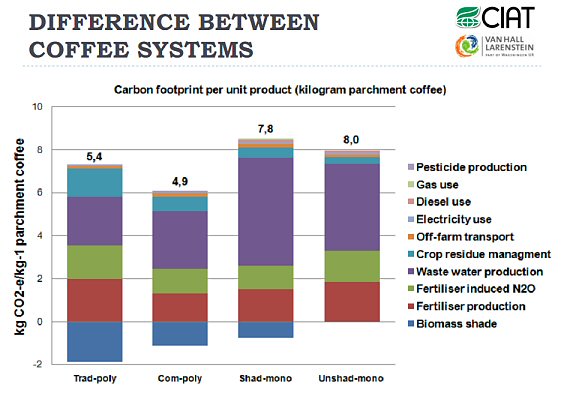
Traditional rustic shade has a larger carbon footprint than commercial polyculture because yields are lower per unit area, and all the contributing factors are allocated to less product. Note that biomass (below 0 on x-axis) denotes “credit” subtracted from factors that add to the carbon footprint.
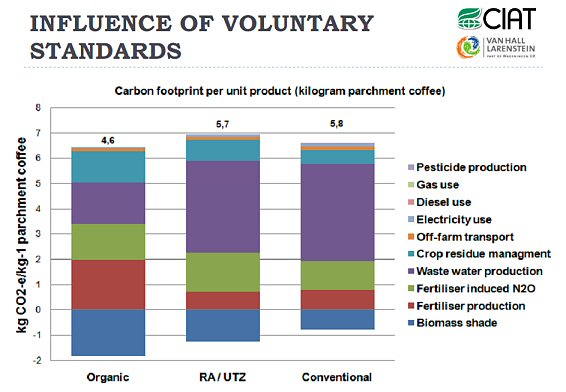
Certifications other than organic don’t do much to reduce carbon footprint over conventional farming, suggesting that standards need to be modified to encourage footprint-lowering practices. Note that biomass (below 0 on x-axis) denotes “credit” subtracted from factors that add to the carbon footprint.

For an explanation of these interesting graphs take a look at the full report.  While it is over 100 pages, it is not a difficult read and I especially encourage people to take a look at page 68, which outlines coffee production practices that result in lowered greenhouse gas emissions, and page 70, which gives overall conclusions.

Climate change impacts on coffee nations

The Center for Global Development recently released data on the vulnerability of countries around the world to climate change. I’ve taken slices of two maps that show the latitudes where coffee is grown. Both maps rank agricultural productivity loss, with countries having the most impact in darker reds, less impact in oranges and yellows.

The top map shows risks due to physical climate change only. Coffee-growing nations (including those growing primarily robusta coffee) ranked at highest risk (top 15) for agricultural productivity loss due to the physical effects of climate change are Central African Republic and Democratic Republic of the Congo, Bolivia, Burundi, Rwanda, the Dominican Republic, and Haiti.

The second map takes into account vulnerability and adjusts these risks based on a given countries’ ability to cope with climate risks. All of the African countries remain in the top 15, with Burundi moving well up the chart (indicating that there are not policies and infrastructure in place to help farmers cope with climate change). Rwanda just leaves the top 15, but Ethiopia now makes the list. The Latin American countries — Bolivia, the Dominican Republic, and Haiti — all move well down the list, but Cuba comes in at 15.

Coffee and climate change updates

It’s been about six months since I gathered together recent resources on coffee-growing and climate change (you can read past material in the new climate change category). Here are some new resources.

Peer-reviewed research related to coffee and/or agroforestry, and climate change:

Coffee and climate change: updated resources

Here are additional resources related to coffee and climate change, including how climate change may impact coffee production, how growing coffee under shade can buffer against climate change, and how shade coffee and habitat preservation on coffee farms can contribute to carbon sequestration.