Certifications

Fair Trade news

This blog focuses on sustainable coffee specifically as it pertains to the environment. I’ve written some about Fair Trade, because there is a connection between poverty and environmental degradation. But Fair Trade is complex, and the issues surrounding Fair Trade coffee alone are numerous. There are many blogs that focus exclusively on Fair Trade, and C&C will continue to deal more with science and leave the economics to the others. But October is Fair Trade month, and there have been several interesting articles on Fair Trade in the media lately. I’d like to just point out a couple.

  • Fair Trade in bloom — New York Times. Discusses the increase in consumer demand for FT products, and how many big companies are jumping on the bandwagon. Specifically highlighted are Sam’s Club and its Brazilian supplier, Cafe Bom Dia. I’ve already written about Cafe Bom Dia. It is an enormous operation. It’s hard for me to believe Bom Dia cannot pay their farmers more than FT prices. I think the Times article is worthwhile to read along with last year’s piece by the Organic Consumers Organization, Wal-Mart’s attempt to sell the “cheapest Fair Trade coffee in America” generates skepticism.
  • Fair Trade coffee price unchanged after 10 years — National Post (Canada). After a recent increase of US$0.05/lb in the social premium (which goes to communities for schools, clinics, etc.), the minimum price for FT coffee paid to the cooperatives is $1.31/lb. When FT pricing was established, coffee was trading around $0.60/lb. Today, when I checked the market price (“C” coffee futures on the NYBOT), it was trading at $1.36/lb, and yesterday’s composite indicator price (how calculated) for arabicas was around $1.40/lb.The FT price is indexed to the market price; it rises to $0.05/lb above the market price if it reaches the FT minimum. I’m not sure which “market price” FT is based upon (I’m pretty sure it’s the C market), or when or how the new FT price is triggered. However, when coffee prices are rising, due to any number of factors including poor weather, the gap closes between the FT and market prices. Then there is less incentive for co-ops to become FT certified (which costs money), diluting FT’s power until prices fall again. Rising prices aside, the FT is not indexed to inflation or (falling) value of the US dollar. This is a challenging time for FT and farmers, and it will be interesting to see how this all unfolds.
Caffe Pronto goes Bird-Friendly

One of C&C’s favorite roasters, Caffe Pronto in Maryland, has just received Bird-Friendly certification from the Smithsonian Migratory Bird Center. Most people associate the SMBC certification with farms, but roasters may also participate. Obviously, they need to sell SMBC certified coffee (although not exclusively), and contribute $0.25 per pound of certified SMBC coffee to Smithsonian, which goes to support the certification program.

Quick look at differing shade criteria

[NOTE: Rainforest Alliance standards have undergone several revisions since this post was first written. There is now no criteria for canopy cover and tree diversity, and native vegetation criteria do not have to be met for six years. The Bird-Friendly standard outlined below has been slightly revised, in part to align with requirements for certifying chocolate; while the older criteria are listed the new standard is still much more stringent than the RA standard. This post should only be for historical reference.]

I recently reviewed a paper, Field-testing ecological and economic benefits of coffee certification programs, that included a  summary table of the criteria used for shade certification by Rainforest Alliance, and Smithsonian Migratory Bird Center (under the “Bird-Friendly” trademark).  I thought it would be useful to post a summary here, with a little commentary.

SMBC’s criteria are mandatory, while RA has no required criteria for shade management — the standards below are one of the optional criteria (more on the RA standards and scoring can be found here).


Criteria SMBC RA
No. tree species >10 >12/ha*
No. trees/ha (mean) na >70*
% allowed to be Inga trees <60 na
% shade cover >40 >40*
No. of shade layers 3 2
% leaf volume in each shade layer
….. >15 m (emergent) >20 na
….. 12 to 15 m (backbone) >60 na
….. <12 m (understory) >20 na
Epiphytes required? Yes na

*As of April 2009, standards were modified from the previous version, February 2008. In the old standards, one requirement was for at least 12 native tree species and at least 70 trees per hectare; now it is an average of 12 native tree species, with no minimum number of trees per hectare. Previous criteria stated a minimum of 40% shade cover, now the standard specifies this minimum only on cultivated land.

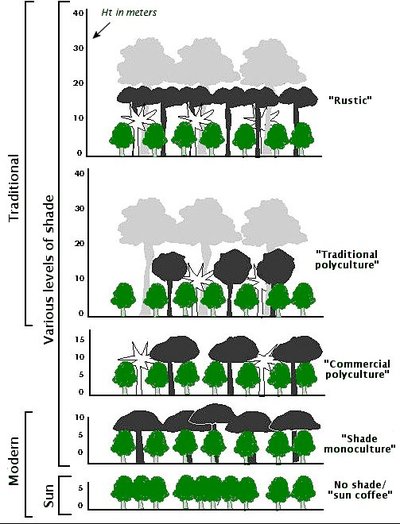
As noted in the previous post, the criteria having to do with vertical stratification — the number of layers of vegetation and the leaf volume in each — are critical components for preserving a rich mix of species.  Many ecological studies support the key role of structural diversity (sometimes referred to technically as floristic heterogeneity) in increased biodiversity — of many types in many ecosystems well beyond the realm of coffee growing. This is the classic schematic illustrating the various coffee production systems and their layers of shade diversity, from a paper by Patricia Moguel and Victor Toledo [1].

Here is a new graphic from SMBC that also illustrates this continuum:

As you can see from the table above, Rainforest Alliance requires (if this criteria is used) only two layers of shade, while Smithsonian requires three. RA has no standards for leaf volume in the shade layers. In short, RA certified farms that use these criteria would have still have structurally-simpler habitats (closer to commercial polyculture) that would likely not support as much biodiversity as farms that met SMBC criteria (closer to traditional polyculture).

A further note. SMBC inspectors visit farms and set up a number of plots and measure various vegetation parameters following methods used in typical ecological studies. The aforementioned paper reports that “Rainforest Alliance inspection auditors rely heavily on data provided by farm managers” (who are not ecologists), and confirm data provided during visits by various estimates and extrapolations.

As an ecologist myself, I am more comfortable that SMBC offers the more stringent, reliable assurance that coffee is grown sustainability if one is comparing certification schemes. And not to beat a dead horse, but the usual caveats apply: there are pros and cons of certification, and many uncertified farms grow coffee sustainably, meeting or exceeding the strongest criteria.

More on SMBCs criteria here, and in the “certifications” category of C&C.

[1] Biodiversity Conservation in Traditional Coffee Systems of Mexico. 1999. Conservation Biology 13:11—21.