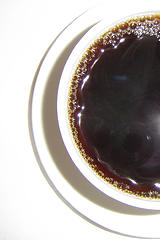
Just to end the year on a unique note, we decided to try an interesting and unique coffee product, cascara. This is dried coffee cherry, and can be prepared as an infusion like tea.
Something old is new again
Although unfamiliar to most Westerners, this is an ancient beverage in Yemen — it may have even pre-dated the actual roasting and brewing of coffee beans. There, and in a few other countries where it is prepared, it’s known as qishar (or qishr, quishar, quishr, keshir, etc.). In Yemen qishar is often made with ginger, sugar, and cinnamon (although many recipes you’ll find will substitute the coffee “husks” with ground coffee).
Enter Aida Batlle!
If anybody in the New World was going to produce and market qishar to the specialty coffee world, it was going to be Aida Batlle, proprietor of three outstanding El Salvador coffee farms — Los Alpes, Finca Kilimanjaro, and Finca Mauritania. She’s committed to quality, sustainability, and innovation.
Coffee is rarely dry processed in Central America due to the damp climate which is so much in contrast with the arid origins of most dry processed beans. But Aida has been experimenting with both dry process and pulped naturals for some time. For her dry process coffee, which she calls “pasa” (“raisin” in Spanish), she leaves the cherries on the tree after they ripen until they dry out and look like raisins. The beans are hulled from the cherries. Normally coffee pulp and skins — from either wet or dry processing — are composted and used for fertilizer. In this case, the dried cherry is used for cascara.
Aida produced around 225 pounds of cascara from her Finca Mauritania harvest. I obtained my cascara from James Hoffman‘s Square Mile Coffee Roasters in the UK, and from Counter Culture Coffee. Square Mile is sold out for the year; I don’t think Counter Culture offered it for sale but used it at tastings and as gifts.
During a visit to Yemen last year, Thom Owen of Sweet Maria’s took a photo of some qishar. It appeared not very uniform, with hunks of hulls and crusty pulp, and it looked dry and flaky. The Finca Mauritania cascara looks much like tree bark, was a rich reddish-brown color, and had a pliable texture.
This bark-like appearance no doubt gave this product its name, as “cascara” refers to tree bark in Spanish. This coffee cascara should not be confused with cascara sagrada, the dried bark of the California buckthorn tree, Rhamnus purshiana. Nearly all Rhamnus have phytochemicals that act as laxatives, and Rhamnus purshiana has long been used as an herbal laxative. Be forewarned that at least in North America, if you Google “cascara” you get lots of hits on the constipation cure, not the coffee tea!
Preparation and taste
The aroma of the raw cascara is powerful and intoxicating. Nearly every person who stuck their nose in the bag said “Wow!” Two descriptions for the smell of the raw cascara came up frequently: raisins and pipe tobacco. The latter aroma sent me back 40 years to sitting on my grandfather’s lap as he smoked a fragrant pipe. Both my husband and I, the only ones from our tasting group that had ever been near coffee mills at harvest time, also recognized the familiar sweet smell of slightly fermented coffee pulp. Licorice came up a couple times, and others detected wine, apple chips, or dried cherries. A few of us tried just chewing on a pinch of the stuff. I thought it was quite good, and the flavor lasted until the chips were well masticated. (This might be the non-liquid solution to a caffeine fix in the field. Bonus: fiber!)
Cascara is brewed like tea. No additional prep is needed — just use the cascara straight from the package. Square Mile recommends a ratio of 20 to 25 grams per liter of water and a 4-minute steep time. Sweet Maria’s advised using the same proportions as brewing coffee, with a steeping time of 4 to 12 minutes, with 8 to 10 minutes being best. Experiment! Your mileage may vary.
Upon brewing, the first thing you’ll notice is that the aroma of the beverage is not like the aroma of the raw material. It has a sort of vaguely grassy smell. One person thought it smelled like wet dog. Nor does it taste like it smells. With lesser quantities or shorter steep times, it is very lightly sweet; all flavors intensify if more cascara is used or it steeps longer.
The first, hottest sip has a citrusy tang; several people said it was orange-toned. Overall, the flavor is somewhat rustic or earthy. It reminded two people of rooibos (except cascara does have caffeine). Rose petal or rose hip tea was also mentioned more than once. If you’ve ever tasted a ripe coffee cherry, that mild sweetness was, as you might expect, there as well. Everybody could find some sort of grassy, green vegetative taste. For me, it was celery. One person said it was like sweetened water from a can of bean sprouts or bamboo shoots! A couple of us thought it had a sort of odd, syrupy aftertaste (it reminded me of sticky coffee pulp). After it had steeped to the color of strong coffee, one person thought it was robust enough to remind them of beef bouillon.
There was some experimentation with milk or sugar, but nobody said additives made a huge difference in how they felt about it. Some people took to the cascara right away, especially if they were regular drinkers of herbal teas. I prefer refined black teas such as darjeelings, but I liked the cascara better after drinking it a few times, so it may be an acquired taste for some people. Everyone was anxious to try it and glad they did, even if they weren’t coffee drinkers — it was just that singular an experience. If you have an opportunity to try some, let me know what you tasted and how you liked it!
And with this last review, I’ll close out 2008. Happy New Year to all C&C readers!

 Six to 27 species of epiphytes were found growing on coffee shrubs in home gardens, and only liverworts were more diverse on forest coffee shrubs. Eleven to 33 species were found on shade trees in home gardens. Overall, epiphyte/bryophyte diversity was higher on forest shade trees, but there was a lot of overlap and many garden shade trees had richer diversity than those in the forest. It was also noted that heavily pruned coffee in more intensively managed farms did not host many epiphytes.