JulieCraves

The sincerest form of flattery

Last year, Counter Culture Coffee launched its Direct Trade program. They also started rolling out their current line of packaging: brown kraft-like valve bags with a sleeve that has nice origin-appropriate art, a map on one side panel showing the source, tasting notes on the other side, and a good description of the farm or co-op on the back. I believe they won an award at a coffee trade show for this labeling.

This year, Starbucks debuted “seasonal coffees.” These coffees are only available for a limited time, and are “harvested in-season when they are at their peak of flavor.”  I’m not sure what Starbucks is really trying to say, since all coffee is harvested “in season.”  Coffee is at its peak flavor when it is fresh — when the green beans have not been sitting around for ages, and when it is freshly roasted. Maybe these seasonal coffees are not as stale as the Starbucks coffee often found on store shelves. But I digress.

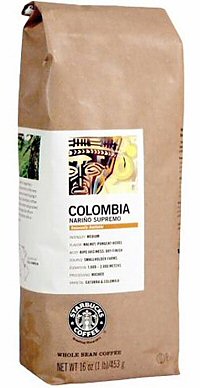
What I really wanted to point out was that the packaging for the new Starbucks seasonal coffee line looks very familiar. A brown (non-valve) bag, with a printed wrap-around-look label with art on the front and tasting notes and a map on the side… You get the picture. If not, here you go:

SCAA coffee awards

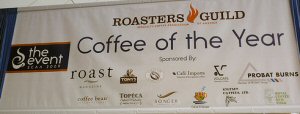
Two coffee competitions took place at the Specialty Coffee Association of America expo in association with The Roasters Guild: the Roaster’s Choice Tasting Award and the Coffee of the Year.

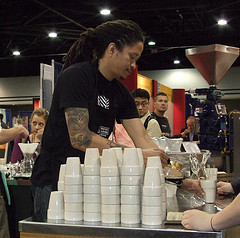
The ten Roaster’s Choice coffees were available for tasting during the expo and everybody was able to cast a vote for their favorite. We had a lot of fun with this last year. The competition was held in a more convenient location then, so we were able to go back more frequently to taste the coffees. Still, it was worthwhile to taste so many flavors in an array of coffees.

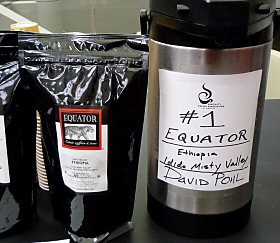
The results were interesting: half the winners Ethiopian, including the top three — two of which were from the same cooperative. Last year the number one coffee was an Ethiopian. The winners are below; I have more info on the top three because they were displayed at the expo. The rest are from a release from the SCAA that only lists the roaster and country of origin (see my comments at the end of the post). Update: I’ve added additional information received in the comments.

1. Equator Estate Coffee & Teas — Ethiopia Idido Misty Valley — roasted by David Pohl.
2. Caffe Pronto — Ethiopia Wondo Worka, Yirgacheffe — roasted by Andy Sprenger (Andy also came in 2nd out of 22 in the first U.S. Cup Tasters Competition, where folks compete to identify coffees in the shortest time in triangulation rounds). This coffee also received a 92 from Coffee Review. Talk about potently floral — wow.
3. Berres Brothers Coffee — Ethiopia Wondo Worka, Yirgacheffe — roasted by John Johnson. This was the only one of the top three that also made my top three. Also distinctly floral, but I like my Ethiopian’s a little more subtle.
4. Flying Goat Coffee — Costa Rica, Cafetin de San Martin micro mill, Terrazu, 2009 crop.
5. Barefoot Coffee Roasters — Ethiopi, Oromiya, Yirgacheffe, Dominion Trading Co. Certified organic. Reviewed at Coffee Review.
6. Tony’s Coffee and Teas — Sulawesi Toraja Peaberry Toarco.
7. Intelligentsia — Ethiopia Yirgacheffe, I presume their Direct Trade Kurimi.
8. Kaldi’s Coffee Roasting — Burundi Kinyovu.
9. Coffeesnobs.com.au — Bolivia Flor de Cafe San Ignacio.
10. Aroma Trading Co. — R&A Javar farms, milled by Pavaraga, Hawaii — roasted by Dan Tang. Exclusive rights on U.S. mainland to Kean Coffee.

Single origin coffees in the Coffee of the Year competition were evaluated by industry cupping professionals in several rounds over the weekend. There were 135 coffees entered. Here are the top ten, with the silly misspellings from the official SCAA press release corrected:

1. Colombia — C.I. Virmax Colombia S.A, Los Naranjos, San Agustin, Huila (88.66).
2. Panama — Hacienda La Esmeralda, Boquete (87.69). After winning first place in 2005-2007, this also came in second to a Colombian last year.
3. Ethiopia — Ninety Plus Coffee, Aricha Micro Selection 14, Yirgacheffe (87.03)
4. Colombia — C.I. Racafe & CIA S.C.A., Santa Maria, Huila (85.78). Racafe came in first place last year.
5. Kenya — Royal Coffee, NY, Gethumbwini Estate, Aberdare Ranges (85.72)
6. Guatemala — El Injerto, S.A., La Libertad, Huehuetenango (85.59). Rainforest Alliance certified; shade is rather low on native diversity, but there is forest reserve on the property as well.
7. Hawaii — Kailiawa Coffee Farm (sponsored by Ka’u Farm and Ranch Company LLC, milled by Pavaraga), District of Ka’u on the Big Island if Hawaii (85.05)
8. Colombia — C.I. Virmax Colombia S.A., La Piramide (Inza, Cauca) (85.00)
9. El Salvador — Exportadora El Volcan S.A. de C.V., Finca Shangrila, Apaneca/Ilamatepec Mountain Range (84.89)
10. Guatemala — San Diego Buena Vista, Acatenango (84.86). Rainforest Alliance certified, came in third out of the Guatemalan coffees in the Rainforest Alliance Cupping for Quality awards, where it scored 83.75.

Sorry, but I’m disappointed in the Roasters Guild and SCAA for the way they publicized the results of these competitions. It took a week for me to dig up the list of winners for the Roasters Choice awards; they didn’t even send a press released to registered media. As I noted, just a list of the roaster and country of origin. There were no other details on the coffee, nor did they give the numbers they were assigned in the blind tasting, so I can’t even tell you which one I liked the best. The press release for the Coffee of the Year was more prompt, but had several misspellings, which I corrected above. Really, it’s embarrassing for the SCAA not to correctly spell “Yirgacheffe.”

Coffee review: Arbor Day blend

Plainspoken Coffee. A Coffee Review for Ordinary People by Ordinary People, #41.

Introduction
The Arbor Day Foundation‘s mission is to “inspire people to plant, nurture, and celebrate trees.”  The first tree-planting holiday, dubbed Arbor Day, took place in Nebraska in 1872. The last Friday in April — today — is National Arbor Day in the United States, celebrated with various tree planting activities.

One of the Arbor Day Foundation’s projects is Rain Forest Rescue, which has supported development of a conservation plan and land purchases in forested areas of Mexico, Belize, and Guatemala. Related to that effort, the organization sells Arbor Day Specialty coffee. In addition to bags ranging from ten ounces to five pounds, various samplers and gift boxes and a coffee club of two bags of coffee a month are also available.

Coffees
The regular offerings are the Arbor Day blend (medium roast), an Italian dark roast, and two flavored varieties (hazelnut and a cinnamon hazelnut). The medium roast Arbor Day blend is also available in decaf through the coffee club. There is currently a limited edition Colombian from Mesa de los Santos which I won’t go into here; I wrote about this Smithsonian Bird-Friendly and Rainforest Alliance certified origin in a previous post.

Aside from the limited edition coffee, there is no further information about the the origins of the Arbor Day selections on the web site. However, I was told that Arbor Day sources from Fair Trade co-ops in Mexico depending on availability: ISMAM and Nubes de Oro.

ISMAM (Indigenas de la Sierra Madre de Motozintla) is a cooperative with nearly 2,000 members of Mayan heritage, growing coffee on 9,700 ha of land, mostly on plots of less than 5 ha. It is based in Tapachula, Chiapas, near the Guatemalan border, and all members have received organic certification. Coffee is grown between 800 and 1600 meters (other sources I’ve seen give the altitude at 1,100 meters; the lowest elevations are robusta coffee, not included in this blend), and is the arabica varieties typica and bourbon.

ISMAM-grown coffee is touted as shade grown. One larger ISMAM farm, the 200 ha Finca Belen, is  Smithsonian Bird-Friendly certified. It’s a farm where Smithsonian researchers have done a number of studies on shade coffee and biodiversity. It’s not possible to determine how much, if any, of the Arbor Day coffee comes from this particular farm. Shade management across 2,000 farms will certainly vary.

Nubes de Oro is also a Chiapas cooperative, located near the El Triunfo Biosphere reserve (see this Starbucks review for more info) and headquartered in Mapastepec. There are over 400 members. As with ISMAM, Nubes de Oro grows typica and bourbon, and the altitude ranges from 900 to 1300 meters. This cooperative is also listed as Smithsonian Bird-Friendly certified, although the certification may involve only some of the members.

The Arbor Day coffees are roasted by The Roasterie in Kansas City — a really good specialty roaster, not some big anonymous commercial roaster, which I think is great.

Review
We reviewed the Arbor Day Blend in both regular and decaf. When I received the coffee, the Fair Trade certified label was prominently displayed, but I had to search for the organic seal. Curious.  Anyway, as advertised this was a medium roast, with most beans showing a sheen of oil, and some with blobs of oil.  There was no roast date on the package (which was not a valve bag), but when hot water hit the freshly ground coffee it did have a decent bloom.

In the French press, this coffee was pleasant, but did not have the acidity we may have expected from a Mexican coffee, especially from Chiapas. Some chocolate notes were there, but more people commented on flavors tending toward nutty or earthy. Several people thought it was sharp, slightly bitter, or better with milk.

Brewed, this harshness was gone for the most part, but it was still not as lively as we would have liked. To be fair, this is in all likelihood, given the season, the end of last year’s crop and therefore would be more apt to be a little dull. One taster said that it didn’t knock his socks off (actually, I think he said “my socks stayed on when I tried it.”). But, he said that didn’t mean it was bad — just a decent cup of coffee. It was just what you’d expect from this origin, balanced, not really complex, a good everyday cup.

I don’t drink much decaf, so I wasn’t sure what to expect from the decaf version. I thought it was better than the regular — a little smoother, without the sharp notes, even in the French press. It had no “off” taste, but was a little weaker than the regular, even when we experimented with grind and brew times. Had I been served this, I would not have known it was decaf.  Overall, these coffees scored 2.75 motmots.

For those seeking decently-sourced, organic, Fair Trade, and generally shade grown coffee — especially by subscription — I’d say to certainly give the Arbor Day coffees a try. In particular I think the average American coffee drinker, who is used to darker roasts or coffee shop coffees, would be pretty pleased with this.

And on this Arbor Day, consider planting some trees. If you order from the Arbor Day Foundation, you will be directed to select trees that will grow in your region. I implore you to make sure to select species that are native to your area. Arbor Day sells a lot of species that are not native to North America, including a few that are considered invasive in some regions. Using native species is really important to keep ecosystems functioning normally — and it will help the same migratory birds than benefit from your choice of shade grown coffee!

SCAA Sustainability Award 2009

The Specialty Coffee Association of America (SCAA) presented its annual awards last night. One is the Sustainability Award, which honors individuals, businesses, or organizations in the coffee industry that have created projects which expand and promote sustainability. Criteria include projects that are innovative and have social, economic and environmental aspects, that can be replicated at different scales, and are inspirational. This year’s award winning project certainly fits the bill.

The 2009 award goes to the ZERI Foundation’s coffee-pulp-to-mushrooms project.  Every coffee farm produces tons of coffee pulp — the final consumable portion of a coffee cherry is less than one percent, so most of the fruit is waste. Something has to be done with it, because it has the potential to pollute waterways if left to ferment and leach into streams. Usually, it is composted and then used as mulch and low-quality fertilizer.

ZERI’s project promotes the use of the pulp to grow mushrooms, which provide a protein-rich food for the community and generate income and jobs when marketed to grocery stores. After the mushrooms are harvested, the used pulp substrate can then be fed to goats, chickens, pigs, or other livestock, which in turn provide additional food as well as manure (to enhance compost).

The ZERI Foundation (Zero Emissions Research & Initiatives) is a “global network of creative minds seeking solutions to world challenges.” The mushroom project was has a rather long an interesting history, which ZERI director Gunter Pauli outlined, along with two women instrumental in working on the project: Carmenza Jaramillo of Colombia and Chido Govero of Zimbabwe. Give it a read, because it is quite exceptional and demonstrates the potential of this project to greatly improve the quality of life in coffee communities — and beyond.

I have a summary of the 2008 winners here, which includes a list of past recipients.