JulieCraves

Climate change and coffee pests

Jaramillo, J., A. Chabi-Olaye, C. Kamonjo, A. Jaramillo, F. E. Vega, H.-M. Poehling, and C. Borgemeister 2009. Thermal tolerance of the coffee berry borer Hypothenemus hampei: Predictions of climate change impact on a tropical insect pest. PLoS ONE 4(8): e6487. doi:10.1371/journal.pone.0006487.

A paper just published in the journal PLoS ONE explores the impact of climate change on the life history and distribution of the world’s worst coffee pest, a minute beetle called the coffee berry borer (CBB), Hypothenemus hampei.

The study modeled potential changes in mortality, number of generations per year, and developmental rate, among other traits, under eight different temperature regimes. The model indicated that CBB successfully develop at 20-30°C, and the intrinsic rate of increase (rate at which a CBB population increases in size) is highest, and the population doubling time lowest, at about 25-26°C (around 77°F).

As mean seasonal temperatures in coffee-growing countries move toward the optimum development temperatures for CBB, these areas become more vulnerable to increasing pest pressure from CBB. This could be especially problematic in Colombia, where multiple flowering of coffee plants means nearly year-round availability of coffee cherries.

The predicted optimal temperature for CBB increase is higher than that which is best for arabica coffee, which prefers a temperature range of 18-21°C (above which yields are reduced), while robusta coffee thrives at temperatures several degrees higher. Climate change is already predicted to reduce area suitable for coffee production. This is probably an even more pressing threat to coffee than changing pest dynamics.

As far as mitigation of the effects of higher temperatures on CBB and coffee production in general, the authors state:

A proven strategy to alleviate the potentially negative effects of climate, especially warmer temperatures, on coffee production is the introduction of shade trees in coffee plantations.

They point out that shade trees can lower temperatures around coffee by up to 4°C at low altitudes (<700 m) and 2°C higher up (>1100 m), that shaded farms harbor more CBB enemies which can provide bio-control of these pests, and that coffee cherry weight and quality is higher when grown under shade, thus offsetting lower yields.

A number of the authors are associated with the International Center of Insect Physiology and Ecology.

Update, March 2011: James Hoffman did an overview of the CBB with some links to climate change research.
Update, September 2011: Further follow-up research by the authors is summarized here.

Photo of a female CBB entering an unripe coffee cherry, part of Figure 1 from the PLoS paper, photo by Gonzalo Hoyos of CENICAFE. Don’t discount small enemies.

Jaramillo, J., Chabi-Olaye, A., Kamonjo, C., Jaramillo, A., Vega, F., Poehling, H., & Borgemeister, C. (2009). Thermal Tolerance of the Coffee Berry Borer Hypothenemus hampei: Predictions of Climate Change Impact on a Tropical Insect Pest PLoS ONE, 4 (8) DOI: 10.1371/journal.pone.0006487


Carbon credits with coffee: a how-to guide

Last spring I posted about a lecture I attended at the SCAA conference on coffee and climate change. I focused on the climate module that Rainforest Alliance is adding to its certification. Part of this initiative was to create a methodology for measuring and verifying carbon stored on coffee farms and a mechanism for producers to receive payments for carbon credits.

Rainforest Alliance partnered with the International Finance Corporation (IFC), part of the World Bank Group; ECOM Agroindustrial Corp., the world’s third largest coffee trading company; and coffee farmers in Mexico and Nicaragua to develop and test these methodologies. They produced a document, “Guidance on coffee carbon project development using the simplified agroforestry methodology.”

The guide is in six parts, and I’ll paraphrase the introduction to outline what each is about:

  1. A general overview of forest and agroforest carbon projects to help the reader understand what a ”project” is and what it is not; what is needed to set a project apart from business as usual practice; and why such projects are important and have value.
  2. Preparation and design of a project, requirements for a Project Design Document which identifies and explains each of the project’s key activities, elements, and important data.
  3. Description of risks to carbon projects’ success and how to assess and lower or manage them.
  4. Explains the processes of independent third party evaluation.
  5. An overview of the financial and contractual arrangements associated with carbon projects.
  6. Glossary and resources.

It’s a pretty straight-forward and non-technical document, and if you are interested I encourage you to download it and give it a look. One of my first thoughts was that this is still well out of the realm of many very small producers who might be only marginally literate. Like all certification schemes, we (the consuming “North”) are imposing a lot of rules and erecting a lot of barriers on farmers to in essence prove they are managing their land in an environmentally-responsible manner so that they might be rewarded for it. I don’t think the average Juan Valdez is going to sit down by the light of his wood-burning stove with this guide and be on his way to selling carbon credits. It will require support and partnership, which in turn requires funding, and ultimately boils down to the need for consumers to be willing to pay more for a sustainably-grown cup of coffee. Which I’ve been saying all along.

Photo by DelosJ under a Creative Commons License.

Shade-grown coffees at Coffee Review

For August 2009, Ken Davids’ Coffee Review takes a look at shade grown coffee. First he describes the definition of the term “shade grown” and goes on to provide reviews of 12 coffees that scored 89 or over. Three were Smithsonian Bird-Friendly certified coffees, others were not certified, but grown under various levels of shade.

There were four coffees earning the highest mark of 92 points:

  • Counter Culture’s Finca Nueva Armenia (Guatemala). Certified organic and Bird-Friendly, this is one of my all-time favorite coffees. I reviewed last year’s crop, and this year it tastes even better. Ken describes a “slight hint of fruit ferment” that I find gives this year’s crop an extremely interesting, deep-toned, subtle wine-like complexity — it’s fantastic! I can be accused of giving a lot of love to Counter Culture, but I can assure you I recommend them and their coffees simply because they just do a bang-up job. Go buy this coffee!
  • Arbor Day Specialty Coffee Mexico ISMAM Co-op. Certified organic and Fair Trade. Coffee is traditionally grown under mixed shade in this region, and one or more of the many farms in this co-op (but not all) is or has been Bird-Friendly certified. I reviewed the Arbor Day Blend, which is sourced either from this co-op, or Nubes de Oro (which scored 91 points in this issue of Coffee Review). I wasn’t as enthused about either of these coffees as Ken, but suspect it was due to the crop I sampled being a little long in the tooth. I don’t see any way on their web site to order either of these Mexican coffees as a single origin, but you can go to the Arbor Day coffee web site and browse around.
  • Ecco Cafe Brazil Santa Terezinha. Organic. Santa Terezinha is indeed one of the only Brazilian farms that makes much use of shade; you can read more about the farming techniques at the blog of the importer, Sustainable Harvest. All the coffees I’ve had from Ecco Cafe have been excellent. I’ll be grabbing a bag of the Santa Terezinha with my next coffee order.
  • Flying Goat, Siberia, El Salvador. Certified organic, typically grown under shade in this region.  A classic, sweet Central from one of my favorite origin coffees.

There are other very nice sustainably-grown coffees in the list, many of which I’ve had and enjoyed. Go take a look at the reviews, the article, and while you’re there, the rest of Ken’s informative and authoritative site.

Cafe Femenino now at Kroger

By now, Café Femenino coffee should be available in many Kroger grocery stores across the nation.

Café Femenino was founded in 2004 by Organic Products Trading Company (OPTCO, the exclusive importer of this coffee) and several other groups to organize and unite female producers in Peru. The project is now active in Mexico, Guatemala, Nicaragua, Bolivia, Brazil, Colombia, and the Dominican Republic. Women are active in all aspects of coffee production, must be on the title of the land, receive extensive training and support and a premium above the established Fair Trade price.

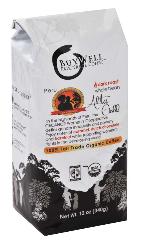
Kroger will be carrying a Café Femenino coffee roasted by BuyWell Fair Trade Coffee: Peru Alta Gold, an organic dark roast produced by 743 women of the CECANOR cooperative in the Penachi region of Peru. (Click here for our review of several BuyWell coffees.) While at the SCAA conference last spring,I spoke with OPTCO’s founders Gay and Garth Smith. I asked which of their Café Femenino countries had the best and most diverse shade, and Peru was the answer.

At the same time, I also attended a screening of a documentary on Café Femenino, Strong Coffee. This was an extremely powerful film about an equally powerful life- and community-changing project.Café Femenino is one of the most worthwhile and transformative projects in coffee today. Kudos to Kroger for making it so widely and easily available.