JulieCraves

Rainforest Alliance impacts report, Part 1

Rainforest Alliance (RA) certified coffee conforms to standards and criteria established by the Sustainable Agriculture Network (SAN). SAN/RA recently released an impacts report. It summarizes the effects of RA certification on farms, farmers, and the environment worldwide for over 100 agricultural crops, and goes into more depth for several important crops, including coffee. I’ll focus, as usual, on issues surrounding biodiversity and habitat on coffee farms.

The report largely presents impacts evaluated through 1) compliance of a sampling of farms to all criteria at the first and most recent audits, and 2) results of studies comparing certified versus non-certified farms.  Here, I’ll look at the farm compliance for coffee farms.

Compliance reports: Revealing an inconsistency

One portion of the report looked at a sample of 68 Central American RA certified coffee farms  (of their 194,356 certified coffee farms worldwide, or 0.03%) and their level of compliance with criteria over time.

Regarding coffee certifications, Coffee & Conservation has been primarily concerned with criteria defining “shade” because those are the guidelines for canopy cover, vegetation structure, and tree species that promote biodiversity-friendly conditions.  In the RA standard, it is Criterion 2.8.

Thus, the most revealing and important fact in the report regarding compliance comes on page 40: “At the initial audit, about 70 percent of certified operations conformed to the requirements of Criterion 2.8 to maintain a diversified shade canopy with at least 12 species per hectare, 40 percent canopy coverage, and two vertical strata.”

Note that this refers to the current shade criterion, but the new standard that is to be published in July is likely to be weaker when it comes to tree and shade requirements.  You can read about the relaxing of these criteria over the years at this post, and the even more lax criteria that were proposed for the new standard here.

The Rainforest Alliance impacts report says 82% of coffee farms comply with current shade requirements. Yet they have said that most farms do not fully implement these requirements, and that’s why they proposed weakening this criterion. The level of conformance increased to 82% by the last (most recent) audit performed. The report goes on to state, ”These results indicate the role of SAN/Rainforest Alliance certification in promoting shade-grown coffee and diversified agroecosystems, which can provide substantial value for biodiversity.”

Seventy to 82% compliance is certainly substantial. Yet in response to my post regarding the weakening of Criterion 2.8 for coffee farms, a Rainforest Alliance representative stated: ”The current criterion 2.8 has not been implemented fully by farms and hence has not been effective in terms of delivering the objective of providing an agroforestry framework that balances both ecosystem services of trees with profitable production scenarios.” A similar statement was made in a document supporting the proposed change, which noted this criterion had proved “impracticable for many producers.”

RA/SAN seem to be contradicting themselves. While the impacts report doesn’t say that the farms examined are representative of all farms, or even Central American farms, RA chose to feature them, implying that they are representative, that the shade requirements are being implemented by a sizable majority of producers, and clearly stating that this indicates the value of RA certification to biodiversity.

Yet to justify lowering the shade requirements in the next version of the standard, RA says that farms are not fully implementing the criterion and it has not been effective. Perhaps the real clue is that RA claims the level of shade now required doesn’t result in “profitable production scenarios.”

However, RA boasts that certification for coffee farms increases income, yield, opens new markets, and provides other economic benefits. In the impacts report, three studies are cited that found revenue was higher on RA certified coffee farms versus non-certified farms.

Is the high compliance presented in the impacts report truly representative? If not, why use it to support a statement that says certification is valuable to biodiversity? If so, why lower the requirements? Are farms that implement the shade requirements really less profitable? If  so, is that due to shade requirements? If not, why lower the criteria?

I think that the high level of compliance with the shade and other biodiversity and environmental criteria as well as the positive economic impacts outlined in the report (which, despite my criticisms, I believe are both considerable and meaningful) demonstrate that RA certification is both achievable, profitable, and beneficial to the environment … at least for the currently certified farms.  The studies reviewed in the impacts report suggest some of the real motivation behind the proposed weakening of some criteria. This will be examined in Part 2.

Update on proposed new Rainforest Alliance standard

SAN-logo[Updates: Since this post, the standard revision, and the merger with UTZ, many of the links in this post have been eliminated; I’ve replaced them with archived links that will hopefully provide historical context. The newest 2020 standard is discussed here.]

Periodically, coffee certification standards and criteria undergo a review process, with modifications made if necessary. The standard used to certify Rainforest Alliance coffee (and other RA-certified products) are developed by the Sustainable Agriculture Network (SAN).

The current SAN standard has been undergoing a fairly long review and revision process. Last year in my post The (de)evolution of Rainforest Alliance shade criteria, I outlined the incremental relaxation of the criteria for shade over agroforestry crops — what the public understands to signify “shade-grown coffee.”

In April of last year, I further described the new proposed standard, which no longer requires a shade canopy over coffee or other shade-tolerant crops for initial certification, and after 3 years only requires “trees and natural areas” covering 20% of total land area. This, in addition to the lowering of other criteria related to tree density and composition, seriously undermines the relevance of the Rainforest Alliance seal for consumers looking for ”shade coffee” that is eco-friendly to birds and other diversity. Please read the previous post and comments for details.

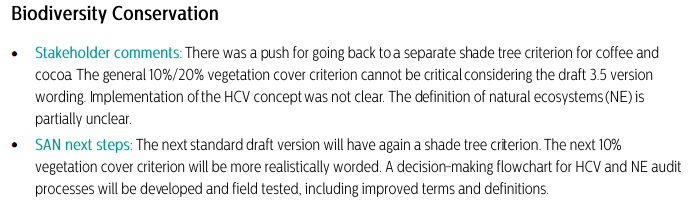
At that time, the public was urged to comment; I did so, as well as consulting with one of the three major bird conservation organizations that also submitted comments. The compilation of the comments shows I was not alone in my dismay at the weakening of the shade standard. Our voices were heard, because this PDF document by SAN summarizing the comments and next steps includes the following section:

ra-shade-comment

This is encouraging — SAN gave the shade tree criterion a second look. The draft the public commented on was version 3.5, and the draft approved last month was reportedly be 4.3. None of the interim drafts were made public (that I know of) and while SAN only stated that the “next standard draft version” would have the shade criterion, we have to assume it will survive through to the the final draft. I’ll be cautiously optimistic that it will also be closer to the current standard, but given the recent trend I don’t want to set my hopes too high. We’ll have to wait and see.

As a result of the comments and additional revisions, the timeline of the whole process was pushed out. The new SAN Sustainable Agriculture Standard will be published in September 2016, and it will be binding for audits on all farms and groups starting July 2017.


McDonald’s sustainability update

mcdonalds-logoI have reported previously on McDonald’s efforts to improve coffee supply chain sustainability, part of a larger effort in overall sustainability. In my post “McDonald’s makes a substantial commitment to coffee sustainability”  I provided an overview of 2013 levels of certified coffee and farmer capacity-building partnerships. I also compared the efforts of this company which derives a relatively small portion of income from coffee to that of JM Smucker (owner of Folgers, among other brands) which makes most of its profit from coffee. I gave a brief recap and update later that year.

In their 2014 Good Business corporate responsibility report, McDonald’s declared an “aspirational” goal (versus a commitment, I suppose) of sourcing 100% of their coffee from third-party verified sustainable sources. As of 2014,

  • 32% of their global coffee (22% in the US) is from sustainable sources, including Rainforest Alliance, UTZ, or Fairtrade certified farms. This is through their network of suppliers, as they do not purchase coffee directly. That is an increase from 2012, when those figures were 25% global, 15% US.
  • 100% of caffeinated coffee is Europe is Rainforest Alliance, UTZ, or Fairtrade certified.
  • 100% of coffee in McDonald’s restaurants in Brazil, Australia, and New Zealand is Rainforest Alliance certified.
  • 100% of espresso in the US and Canada is Rainforest Alliance certified.
  • Their grocery store Espresso Roast McCafe at Home brand is 100% Rainforest Alliance certified. The bagged McCafe coffees in grocery stores are roasted by KraftHeinz.  Kraft went through a series of spin-offs and mergers, and retained some coffee operations and brands, including Maxwell House, Gevalia, and Tassimo.

These are significant efforts for a fast food chain and, as noted in my previous posts, more impressive than some coffee companies. Because McDonald’s buys through suppliers that also serve other companies, pushing the suppliers to source more certified coffees should also have positive spillover effects in the larger market.


Coffee growing bibliography update

journalsI have made another periodic update to my coffee bibliography, peer-reviewed papers that deal with various ecological and economic aspects of coffee growing.  Now that the list is over 400 papers, I thought it might be useful to publish a list of the most recent additions when I update the larger list.

Here are the most recent ones. Note that not all are new publications, because when I read new literature, I often find references to older papers I missed. I’ve included the abstracts of papers I found particularly interesting, revealing, or relevant. Warning: long and nerdy!

Barham, B.L., M. Callenes, S. Gitter, J. Lewis and J. Weber. 2011. Fair Trade/Organic coffee, rural livelihoods, and the ”agrarian question”: southern Mexican coffee families in transition. World Development 39: 134—145.

Barham, B.L. and J.G. Weber. 2012. The economic sustainability of certified coffee: recent evidence from Mexico and Peru. World Development 40: 1269—1279.

Consumers increasingly act on preferences for a more just and sustainable world by purchasing certified agricultural products. Using survey data from coffee growers in Mexico and Peru, we explore the economic sustainability of certified coffee, looking at conventional, Fair Trade/organic, and Rainforest Alliance certified growers. The analysis reveals that yields rather than price premiums are most important for increasing net cash returns for coffee growing households. Given the link between net returns and producer participation in certified coffee schemes, the findings suggest that certification norms that permit improving yields are essential for improving grower welfare and attracting and maintaining growers.

De Beenhouwer, M., L. Geeraert, J. Mertens, M. Van Geel, R. AcuÁ±a Castillo, K. Vanderhaegen and O. Honnay. 2016. Biodiversity and carbon storage co-benefits of coffee agroforestry across a gradient of increasing management intensity in the SW Ethiopian highlands. Agriculture, Ecosystems & Environment 222: 193—199.

Bravo-Monroy, L., S.G. Potts and J. Tzanopoulos. 2016. Drivers influencing farmer decisions for adopting organic or conventional coffee management practices. Food Policy 58: 49—61.

Colombia is one of the world’s most important producers of Arabica coffee (Coffea arabica), whose coffee-growing zone coincides with a biogeographic hotspot of biodiversity. Given that coffee agroecosystems are grown by both organic and conventional schemes of management in Santander, a region which produces coffees with specialist distinctive flavours, this study aims to better understand the factors that influence the adoption of these different schemes of management. A combination of ethnographic techniques and quantitative methods were used to examine the predominant drivers of adoption and revealed farmer perceptions associated with coffee farming, and the complexity of interacting factors, that surround their decision making. The results of qualitative analysis suggests that social identity of coffee growers, the existence of farming spaces (lived, perceived, rationalised), the influence of coffee institutions, attitudes about management practices, and social relations of production, all play an important role in the process of decision making. In quantitative terms, we identified 18 socioeconomic drivers, some with interacting effects that had significant influence on the decision to adopt either organic or conventional practices. In particular, at local scale, important factors were technology availability, the type of landowner, formal education of farmers, the role of institutions, membership of community organisations, farm size, coffee productivity and the number of coffee plots per farm. Likewise, economic drivers, such as crop profitability, determined how farmers are involved in trade and market networks at broad regional, national, and international spatial scales. By adopting a more integrated approach, combining qualitative and quantitative methodologies, we characterised the complexity of factors that influencing adoption of coffee management schemes and show that not only financial factors but also a variety of other social factors drive farmer decision making. Identifying the most influential behavioural drivers provides policy with opportunities to better support farmer livelihoods.

Chaves, B. and J. Riley. 2001. Determination of factors influencing integrated pest management adoption in coffee berry borer in Colombian farms. Agriculture, Ecosystems & Environment 87: 159—177.

Faure, G., J.-F. Le Coq, I. Vagneron, H. HocdÁ©, G.S. MuÁ±oz and M. Kessari. 2012. Strategies of coffee producers’ organizations in Costa Rica toward environmental and social certification processes. Cahiers Agricultures 21: 162—168.

GuzmÁ¡n, A., A. Link, J.A. Castillo and J.E. Botero. 2016. Agroecosystems and primate conservation: Shade coffee as potential habitat for the conservation of Andean night monkeys in the northern Andes. Agriculture, Ecosystems & Environment 215: 57—67.

Haggar, J., M. Barrios, M. BolaÁ±os, M. Merlo, P. Moraga, R. Munguia, et al. 2011. Coffee agroecosystem performance under full sun, shade, conventional and organic management regimes in Central America. Agroforestry Systems 82: 285—301.

Changes in coffee economics are leading producers to reduce agrochemical use and increase the use of shade. Research is needed on how to balance the competition from shade trees with the provision of ecological services to the coffee. In 2000, long-term coffee experiments were established in Costa Rica and Nicaragua to compare coffee agroecosystem performance under full sun, legume and non-legume shade types, and intensive and moderate conventional and organic inputs. Coffee yield from intensive organic production was not significantly different from intensive conventional in Nicaragua, but in Costa Rica it was lower during three of the six harvests. Full sun coffee production over 6 years was greater than shaded coffee in Costa Rica (61.8 vs. 44.7 t ha−1, P = 0.0002). In Nicaragua, full sun coffee production over 5 years (32.1 t ha−1) was equal to coffee with shade that included Tabebuia rosea (Bertol.) DC., (27—30 t ha−1) and both were more productive (P = 0.03) than coffee shaded with Inga laurina (Sw.) Willd. (21.6 t ha−1). Moderate input organic production was significantly lower than other managements under all shade types, except in the presence of Erythrina poepiggina (Walp.) O.F. Cook. Inga and Erythrina had greater basal area and nutrient recycling from prunings than other shade species. Intensive organic production increased soil pH and P, and had higher K compared to moderate conventional. Although legume shade trees potentially provide ecological services to associated coffee, this depends on management of the competition from those same trees.

Hardt, E., E. Borgomeo, R.F. dos Santos, L.F.G. Pinto, J.P.P. Metzger and G. Sparovek. 2015. Does certification improve biodiversity conservation in Brazilian coffee farms? Forest Ecology and Management 357: 181 — 194.

Socio-environmental certification uses evaluation criteria to promote the conservation of the natural environment and landscape connectivity, with the aim of constructing agricultural landscapes more suitable for biodiversity conservation. To test this, we examine whether socio-environmental certification of Brazilian coffee farms contributes to local conservation, particularly in terms of deforestation control, habitat protection and regeneration, and connectivity. The analysis compared changes in landscape structure and connectivity in certified farms before (1995—2002) and after nine years from the beginning of the certification process (2002—2011), using as a reference the surrounding landscape and a control group of non-certified farms. To quantify changes in landscape connectivity we used probabilistic indices of functional connectivity based on graph theory, and two species of terrestrial mammals with contrasting dispersal capacities and habitat requirements: Priodontes maximus (giant armadillo) and Marmosops incanus (gray slender mouse opossum). Our results show that changes in the last decade have been subtle, but that certified farms differ from surrounding areas for the greater deforestation control and habitat availability for both land cover types, and for the greater connectivity for P. maximus. The difference between certified and non-certified farms is not clear-cut, however, we have evidence that the certified farms contributed more than the surrounding areas to the conservation of the studied species when the balance of gains and losses of connectivity is considered. The subtle differences in temporal changes and groups might be partially explained by the fact that certified farms already had a different conservation profile at the beginning of the certification process. Despite the limitations in the sampling size (small number) and time scale (only nine years after certification) which may hinders the detection of certification effects, our findings indicate that certification was important in controlling deforestation and the conversion of new natural areas to agricultural lands.

de JesÁºs-Crespo, R., D. Newsom, E.G. King and C. Pringle. 2016. Shade tree cover criteria for non-point source pollution control in the Rainforest Alliance coffee certification program: A snapshot assessment of Costa Rica’s TarrazÁº coffee region. Ecological Indicators 66: 47—54.

Management of non-point source pollution is of great importance in the context of coffee agriculture, as this land use often coincides with headwater streams that influence water quality at the basin scale. Sustainability certification programs, such as the Rainforest Alliance (RA), provide management guidelines that promote non-point source pollution control in coffee. One of these practices is the maintenance of shade trees within farms, required by RA at a minimum of 40% shade tree cover. Here we assess the effectiveness of this practice in TarrazÁº, a high elevation coffee growing region in Costa Rica. We monitored indicators of non-point source pollution in streams with both high and low shade tree cover. Streams with High Shade Tree Cover (HSTC, N = 5 subwatersheds) had 35—55% cover, approximating or exceeding the RA recommendation of at least 40%; and streams with Low Shade Tree Cover (LSTC, N = 5 subwatersheds), had 18—31% cover. We monitored the ten study streams during the dry (April & December), transition (July), and peak (October) rainfall seasons of 2013, and compared responses using t-tests. We found support for the effectiveness of shade tree cover in controlling non-point source pollution: HSTC streams had significantly (p = 0.042) lower mean annual turbidity and significantly (p = 0.004) lower turbidity during the transition season. HSTC streams also had significantly (p = 0.05) lower conductivity values during the transition period, although this trend was weaker through the year. Subwatersheds with HSTC streams were characterized by a higher percentage of RA-certified coffee than LSTC streams. Our study provides evidence of the benefits of RA shade tree cover criteria for managing water quality within high elevation tropical agro-ecosystems, especially if implemented at the watershed scale. These results contribute to our understanding of the role of agroforestry certification on tropical ecosystem conservation, and are the first account of the effectiveness of a specific coffee certification guideline on non-point source pollution control.

Mansingh, G., H. Reichgelt and K.-M. Bryson. 2007. CPEST: An expert system for the management of pests and diseases in the Jamaican coffee industry. Expert Systems with Applications 32: 184—192.

MarÁ­n, L., S.M. Philpott, A. De la Mora, G. Ibarra NÁºÁ±ez, S. Tryban and I. Perfecto. 2016. Response of ground spiders to local and landscape factors in a Mexican coffee landscape. Agriculture, Ecosystems & Environment 222: 80—92.

MariÁ±o, Y.A., M.-E. PÁ©rez, F. Gallardo, M. Trifilio, M. Cruz and P. Bayman. 2016. Sun vs. shade affects infestation, total population and sex ratio of the coffee berry borer (Hypothenemus hampei) in Puerto Rico. Agriculture, Ecosystems & Environment 222: 258—266.

McCook, S. and J. Vandermeer. 2015. The big rust and the Red Queen: long-term perspectives on coffee rust research. Phytopathology: PHYTO—04—15—0085—RVW.

Milligan, M.C., M.D. Johnson, M. Garfinkel, C.J. Smith and P. Njoroge. 2016. Quantifying pest control services by birds and ants in Kenyan coffee farms. Biological Conservation 194: 58—65.

Ecosystem services, such as pest control and pollination, are critical benefits of biodiversity important for agricultural production. Predators, including insectivorous birds and ants, can provide important biological controls in agroecosystems, boosting crop yield and offsetting the need for expensive inputs such as pesticides. Local habitat and landscape characteristics can affect the delivery of ecosystem services, thereby influencing optimal land allocation for crop production and biodiversity. In order to better understand the relationship between ecosystem services and the surrounding habitat, we conducted a sentinel pest experiment to investigate predation levels in response to a novel pest on coffee farms in central Kenya. The frequency of predation decreased significantly with increasing distance from adjacent forest fragments and was correlated with bird species richness. Predation was also significantly higher on shade compared to sun coffee farms. We conclude that a land sharing approach, via both the integration of shade trees and the conservation of small forest fragments within or adjacent to a farm, can support increased levels of pest control services provided by birds and ants in Kenyan coffee farms.

Perfecto, I., J. Vandermeer and S.M. Philpott. 2014. Complex ecological interactions in the coffee agroecosystem. Annual Review of Ecology, Evolution, and Systematics 45: 137—158.

Rueda, X. and E.F. Lambin [online]. 2013. Responding to globalization: impacts of certification on Colombian small-scale coffee growers. Ecology and Society 18.

Rueda, X., N.E. Thomas and E.F. Lambin. 2014. Eco-certification and coffee cultivation enhance tree cover and forest connectivity in the Colombian coffee landscapes. Regional Environmental Change 15: 25—33.

Segura, H.R., J.F. Barrera, H. Morales and A. Nazar. 2004. Farmers’ perceptions, knowledge, and management of coffee pests and diseases and their natural enemies in Chiapas, Mexico. Journal of Economic Entomology 97: 1491—1499.

Soto-Pinto, L., Y. Romero-Alvarado, J. Caballero-Nieto and G. Segura Warnholtz. 2001. Woody plant diversity and structure of shade-grown-coffee plantations in Northern Chiapas, Mexico. Revista de BiologÁ­a Tropical 49: 977—987.

Valencia, V., S. Naeem, L. GarcÁ­a-Barrios, P. West and E.J. Sterling. 2016. Conservation of tree species of late succession and conservation concern in coffee agroforestry systems. Agriculture, Ecosystems & Environment 219: 32—41.

Valencia, V., P. West, E.J. Sterling, L. GarcÁ­a-Barrios and S. Naeem. 2015. The use of farmers’ knowledge in coffee agroforestry management: implications for the conservation of tree biodiversity. Ecosphere 6: 1—17.

Weber, J.G. 2011. How much more do growers receive for Fair Trade-organic coffee? Food Policy 36: 678—685.

Wollni, M. and B. BrÁ¼mmer. 2012. Productive efficiency of specialty and conventional coffee farmers in Costa Rica: Accounting for technological heterogeneity and self-selection. Food Policy 37: 67—76.