Review: Coffees from India
Plainspoken Coffee. A Coffee Review for Ordinary People by Ordinary People, #47.
In the overview of coffee growing in India, I promised some reviews. The crew here at C&C has, in fact, been busy drinking multiple offerings from India. We hope to do at least two posts, each with several short reviews.
We start off here with reviews of several non-traditional coffees. We purchased these from Muddy Dog Coffee Roasting in Morrisville, NC.
Sethuraman Estates Liberica
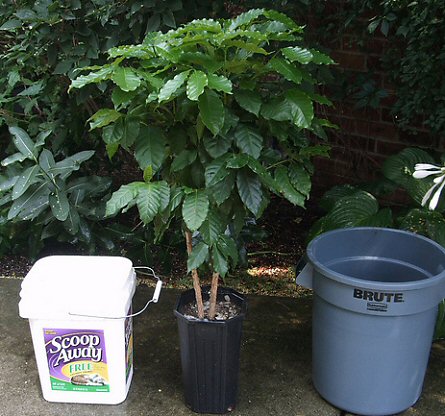
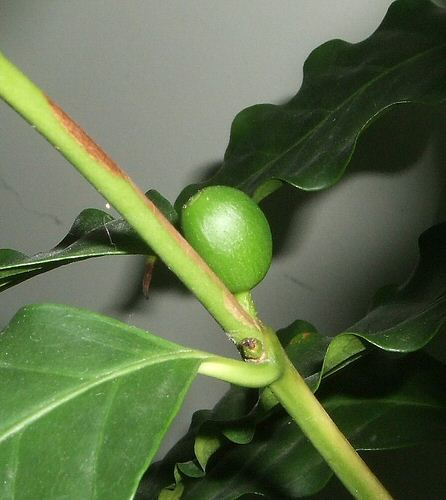
 This is certainly one of the most unusual mainstream coffees (versus novelty coffee such as Kopi Luwak) currently available. Two species of coffee make up nearly all coffee on the market today: arabica (Coffea arabica) and robusta (C. canephora). Coffea liberica is a species native to west and central Africa, and accounts for only about 1% of world trade. It is a large tree with big, leathery leaves often grown on roadsides or as a windbreak.
Sethuraman Estates is in the Chikmagalur region of Karnataka state, near the town of Magundi and the Bhadra Wildlife Sanctuary. By all accounts, including this excellent one by Muddy Dog owner Jim Pelligrini, there is ample shade and lots of wildlife on the farm. Much of the coffee at Sethuraman is grown organically, and part of the estate is in the process of being certified. Coffee is fertilized with estate-produced worm compost, and other environmentally-friendly practices have been initiated, including the installation of new water-conserving processing equipment.
This coffee is grown at about 900 m, and prepared as a pulped natural. The aroma of the ground coffee as well as the first taste is very fruity — there is the strong suggestion of blueberries, as in a dry process Ethiopian, but there are components of other dark fruit (plum was mentioned by one taster) as well as cherry. A fruit brandy or liqueur flavor was agreed on by multiple tasters, leading a couple of people to say it would be good as an after-dinner coffee.
As the coffee cooled, several drinkers who tended to favor milder coffees were put off by the sour notes that emerged. It wasn’t harsh or sharply sour — in fact, overall the coffee was remarkably smooth. On the other hand, the finish reminded one German taster of sauerbraten — in a good way. “I did not expect to have this kind of experience from coffee!!!” was his remark. I have seen this coffee described elsewhere as “meaty.” This may represent savory or umami aspects of the profile. We (gratefully) did not come up with “animal-like flavors of jackfruit…and mint.”
The first few sips are indeed powerful, and perhaps could be considered challenging to many. We found it was more approachable in a French press than as a drip.
 I was a little surprised that such an assertive coffee was liked by so many people. Nobody dismissed it, and most people agreed that while they wouldn’t want to drink it every day, they’d try it again. A few were very enthusiastic. When scores from the larger-than-usual panel were averaged, the final score was 3.25 motmots, very respectable for such an unusual coffee. Please give it a try!
By the way, liberica has a higher caffeine content than arabica (beans at about 1.4% caffeine versus around 1%), but less than robusta (1.7%)[1], although nobody thought it produced any more buzz than usual.
Monsooned Malabar
 I think for Americans, Monsooned Malabar is the coffee most associated with India. The name is a legal Geographical Indication, indicating that the coffee comes from a particular region. In this case, Monsooned Malabars are processed coffee beans (usually, maybe always, dry processed) exposed to the annual monsoon winds in warehouses along the Malabar coast of India. This unusual treatment is deemed necessary to replicate the unique taste and character of Indian coffees that were once transported to Europe on sailing vessels and subjected to months of humidity on the journey. As the beans absorb moisture, they swell and turn pale. Again, Jim of Muddy Dog has a great blog post on how the process proceeds in modern times: How Stuff is Made: Monsooned Malabar Coffee.
There are a number of adjectives that invariably pop up in descriptions of Monsooned Malabars: earthy, woody, pungent, wild, funky, low-acid, and heavy or syrupy-bodied. Unadventurous coffee drinkers might balk at a coffee described this way. Usually roasters don’t recommend Monsooned Malabars to people who like sweet, bright coffees. I consider myself solidly in that group, yet I really enjoyed this coffee.
The tasting panel did find some of those flavors in this coffee, but they were nowhere near as odd, unpleasant, or unappealing as this coffee’s reputation had lead us to expect. We found this coffee well-rounded, with pleasing tones of earthiness, leather, and smoke. There was a very agreeable rustic, musty nuance that added character to the overall mellowness of the coffee. Really no hint of fruit, despite the dry processing.
 Nobody gave this coffee less than 3 motmots, and the average score was between 3.25 and 3.5 — so we’ll go with 3.5 to encourage people to give it a try. Whereas many Indian coffees are hard to come by, Monsooned Malabars are not terribly hard to find. Some roasters even offer single-estate origin Monsooned Malabars. On the other hand some also have monsooned robustas, and many roasters are just not sourcing very high quality monsooned coffees, or have the skill to roast them correctly. I assume that’s why so many Monsooned Malabars are described as extreme or intense. Choose a roaster carefully. I know our positive experience with this coffee was due in large part to Muddy Dog’s honoring the bean’s interesting profile.
Kaapi Royale Cherry Robusta
This robusta selection is also from Sethuraman Estates, grown lower than the liberica, at 750 m. “Cherry” in regards to Indian coffee means a natural or dry process. Much of the world’s bad supermarket coffee is made up of cheap robusta. However, there are some carefully grown and processed robustas used in espresso blends. Typically, people don’t drink robusta straight, with the exception of the occasional single-origin espresso shot. Since we have so far not branched out into espresso prep reviews, we bravely prepared this sample as a drip and in a French press.
Robusta beans have a distinctive rubber flavor, and a bitterness that comes from the high caffeine content. When prepared in my Technivorm drip coffee maker, these characteristics were a bit more emphatic than they were when prepared as a French press. Because a sourness also developed as the coffee cooled, making this coffee in any typical consumer drip coffee maker would surely accentuate the most formidable aspects, while drowning out the intriguing properties. Thus, we proceeded with several trials in the press.
 Although a dry processed coffee, fruit was not the dominant feature. There was no mistaking it was a robusta — the “rubber” was there — but it was tempered by semi-sweet chocolate, wood, and earth. It was not bitter, but very, very smooth. Nobody found this offensive. While everyone agreed this wasn’t something they’d go out and buy a bag of, they liked the idea of a cup now and then, and very much appreciated an opportunity to taste a high quality robusta, rather than the crap in supermarket coffees. It ended up with a respectable 2.75 motmots.
A future review will cover some more traditional, single-estate arabicas from India.
We’d like to thank Jim Pelligrini for putting together a great package of Indian coffees for us to buy and try out. Nor can we neglect to also thank Allen Leibowitz of Zingerman’s Coffee Company for inspiring us to embark on exploring Indian coffees.
[1] Ashihara, H. and A. Crozier. 2001. Caffeine: a well known but little mentioned compound in plant science. Trends in Plant Science 6:407-413.
 Rumor has it that four of their current offerings will be replaced by the new coffees. They are the Fair Trade certified Café Estima Blend, the decaf Café Verona, the decaf House Blend, and the Organic Shade Grown Mexico. In response to my specific inquiry, I have confirmation from Starbucks that the latter will indeed be discontinued.
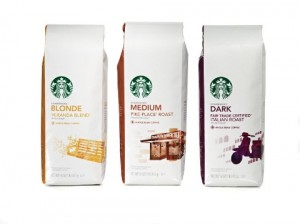 In any event, the Blonde roast roll out will coincide with an overhaul of coffee packaging/branding at Starbucks to emphasize the three roast levels (with the lightest being Blonde, which is