JulieCraves

Colombia to produce more RA coffee

According to this article in Financial Express, by 2007, ten percent (about 1 million 60 kg bags) of Colombia’s coffee will be certified by social and environmental programs. One of these programs is the Rainforest Alliance sustainable agriculture program (my overview here).  Colombia is one of Latin America’s top producers of sun coffee, so this is a step in the right direction.  Meanwhile, look for Colombia’s Mesa de los Santos coffee, which is certified organic and shade grown (by both Smithsonian and Rainforest Alliance). Review at Coffee Cuppers, and carried by a number of the roasters in the sidebar.

Starbucks responsible coffees

Under the Starbucks category, you can read more about the company’s struggles with committing to Fair Trade and environmentally-responsible coffees.  In particular, Green LA Girl has two posts (here and here) regarding the Starbucks point-based CAFE Practices as they compare to Fair Trade. (Update: an in-depth overview of the latest version of CAFE Practices and their environmental standards here.)

Many people go to Starbucks and want to know — or should know — about which coffees are their most responsible. Here is a run-down on their current offerings.

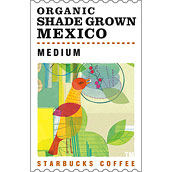
  • Organic Shade Grown Mexico.  Medium roast, origin Chiapas, Mexico.  Grown near the El Triunfo Biosphere Reserve, a park threatened in part by coffee plantations. This is one of the coffees produced in partnership with Conservation International, their “Conservation Coffee.”  Although the description on the Starbucks web page says “traditional shade-growing,” as noted in the post about the partnership, it does not appear that these coffees are grown with any specific or enforced rules regarding degree of shade management or level of organic practices.  Therefore, it does not seem that this coffee is comparable to coffees that are certified organic or bird-friendly. (Update: review and background of this coffee here.)
  • Shade grown Mexican decaf. Medium roast, origin Chiapas, Mexico. Description makes it sound like the same coffee as above, yet it is not labeled organic.
  • Serena Organic. Medium roast, origin Latin America and east Africa. No indication what organization, if any, certifies this as organic.  Coffee Review review.
  • Cafe Estima. Bold roast, origin not specified.  Their featured “Good Coffee, Doing Good” blend.

Starbucks has a line of Black Apron limited edition coffees. They give $15,000 to the farmers of each Black Apron coffee for community projects.  These beans are pricey, and $3 of each half pound must go into producing the fancy laser-cut box.  I just tried the Rwanda Blue Bourbon Black Apron, which is just about at the end of its run, and liked it quite a bit.  But then, I’m a fan of Rwandan coffees.

On the one hand, I give Starbucks some credit for attempting to buy and market responsible coffees; the fact they do it is what counts for me, I don’t care whether they are dragged into it kicking and screaming.  On the other hand, I personally am not a Starbucks fan and think a lot of their coffee is over-roasted.  Click on the Starbucks category for more on the company’s coffees and policies.

Caribou Coffee and Rainforest Alliance

Caribou Coffee, based in Minneapolis with stores in 15 states, announced last July that it was partnering with Rainforest Alliance (RA) to provide certification for much of their coffee.  They expected 20% of their coffee to be certified by the end of 2006, with a goal of half of all the green beans purchased to be RA certified by 2008.  The phase-in is necessary because Caribou wants to preserve existing relationships.  This has an upside in that new producers will be adhering to certification standards.  Considering that a number of Caribou offerings are from Africa and Asia, which are not eligible for shade certification and which often are grown under shade as a matter of course, this means that well over half of Caribou’s coffees will represent shade coffees, in one shape or form.

(Update: 100% of all Caribou coffees will be 100% Rainforest Alliance certified by 2011. More on this here.)

As the second largest U.S. specialty coffee company, selling over 4 million pounds of coffee annually, the purchase of half their beans from certified sustainable sources is nothing to sneer at, and it makes Caribou one of the only big coffee houses where this kind of sustainable coffee will be readily available.

Caribou has a commitment to responsible coffee sourcing, social responsibility (including work in coffee growing areas) and frequently donates to local communities and charities.

Botanical varieties of coffee

There are over 100 species of coffee (Coffea) in the world, and all are native to tropical Africa and some Indian Ocean islands (Madagascar, Macerenes). Most have very limited distribution, and over 70% are threatened with extinction.

Usually only two species, C. arabica and C. canephora, are commonly grown commercially.  They are described below, along with a few other interesting species, and the most common commercial varieties of these species.  Because certain types grow best in the shade and others in the sun, knowledge of these names can be a convenient clue as to how your coffee may have been grown.

Don’t confuse these botanical varieties with coffees named for their growing regions, such as Ethiopian Harrar, Guatelmalan Antigua, or Hawaiian Kona.

  • Coffea arabica. This is the highest quality coffee, used by specialty roasters. It grows best at higher altitudes — 3000 to 6500 feet — and because it grows slowly the flavors are more concentrated. This species tend to be susceptible to various diseases, and has a lower caffeine content than C. canephora (below). Arabica is a deep-rooted shrub. Unlike other coffee species, arabica has two sets of chromosomes. Arabica has two common varieties, typica and bourbon. These traditional, older varieties are the types most often grown in the shade. Because arabica is self-pollinating, these varieties are stable, but sometimes do mutate into strains that are then cultivated. Just a few of the most common are described.
    • Coffea arabica var. typica.
      • Maragogype — large-beaned (“elephant bean”) Brazilian mutation. Porous beans are not especially flavorful, and low-yielding. (Roasting a larger bean correctly takes some finesse, so buy from a specialty roaster.)
    • C. a. var. bourbon. Old variety originating on the Indian Ocean island of Bourbon (Reunion) with broad leaves, and small fruits. In Kenya, bourbons are sometimes called “French mission ” or “Scottish mission.”
      • Catuai — cross between Mundo Novo and Caturra. There are red (rojo) and yellow catuais, named for the color of the cherries. High yield and hardy. Often grown as sun coffee.
      • Caturra — compact, multiple-branching form of bourbon, common in Brazil and Colombia. Disease resistant and fast-maturing, the higher yield of Caturra apparently comes at a cost to good taste. Considered lighter-bodied and more acidic than traditional bourbons. Often grown as sun coffee, it requires a lot of management and fertilizer.
      • Mundo Novo — cross between typica and bourbon, high yield, popular in Brazil.
      • Paca — a high yielding cross between bourbon and Caturra.
      • Pacamara — cross between Maragogype and the Paca variety of Caturra.  Not considered very flavorful, as neither parent is especially revered for taste.

If you’d like to see a “family tree” of some of the arabica coffee varietals, check out this post by Jim Hoffman and a table of coffee genotypes from a paper published in the Brazilian Archives of Biology and Technology. More less-commonly referred to arabica varieties are described in the coffee glossary.

  • Coffea canephora.  This species is more commonly referred to as “robusta,” although this actually refers to the upright variety of canephora; there is a spreading variety known as nganda.  Robusta is a lower-growing and shallow-rooted, harsher and more bitter variety that is used in cheaper coffees, or as fillers.  Robusta tends to be more hardy and disease-resistant, will grow better in the sun than arabica, and tends to have higher yields. It has a higher caffeine content than arabica. I’ve written an entire post about robusta here.  Although there is such a thing as a decent quality robusta, Kenneth Davids at Coffee Review sums up the problem with most robustas in today’s market:

    Apparently with the support of the World Bank, robustas recently have been planted in very large quantities in Vietnam. These are mass-produced coffees at their most dramatic: stripped from the trees, leaves, unripe, ripe and overripe fruit and all, and dried in deep piles. All of which means the essentially bland, grainy robusta character is topped off with an assortment of off-tastes, mainly musty/mildewed and fermented. These coffees sell for considerably less than all other coffees, including better quality robustas. I am told that production costs for Vietnamese robustas are about 20 cents per pound or less, compared to, for example, production costs of 80 to 90 cents per pound for the excellent “100% Colombia” coffees competing in the supermarket. And now the current episode: Commercial dealers and roasters have learned to steam the often foul-tasting Vietnamese robustas, removing the waxy covering of the bean and muting (but not entirely eliminating) the offensive flavor notes.

There are some hybrids between arabica and canephora. They include:

  • Hibrido de Timor — a natural hybrid, with two sets of chromosomes like arabica.
  • Icatubackcrosses of Hibrido de Timor with Mundo Novo or Caturra.
  • Catimor — cross between Caturra and Hibrido de Timor. High yields, often grown as sun coffee, with a reputation for inferior quality.

One other species is grown commercially:

  • Coffea liberica. Similar to robusta, grown at low altitudes in Malaysia and West Africa, it accounts for less than 1% of commercial trade. In the cup, it is thick and pungent, but has its fans in some countries.  It is known as Barako in the Phillipines.  Two subspecies are commonly recognized, C. liberica var. liberica, just called “Liberica” or “Liberian” coffee, and C. liberica var. dewevrei, known as “Excelsa.”

There are a number of varieties in Madagascar and the Mascarene Islands that have little or no caffeine, including C. kianjavatensis, C. lancifolia, C. mauritiana, C. macrocarpa and C. myrtifolia. These species are in the taxonomic section Mascarocoffea; this is not a genus as is frequently reported on the Internet. Arabica and robusta coffees are in the section Eucoffea, and attempts to breed Eucoffea varieties with caffeine-free traits from Mascarocoffea types has not been successful.

Finally, peaberry (“caracol”) coffee is not a botanical variety, but a bean mutation where the cherry produced one small, rounded, fused bean rather than two flat-faced beans. May occur in any botanical variety, usually accounting for about 10% of the crop.  Some think peaberries have a superior taste, but choose a roaster widely, since peaberries roast quickly and are easily charred.