JulieCraves

Northwest Shade Coffee Campaign update

Update: As of 2013, the NSCC is no longer functioning. This post is informational only.

In March 2006, I posted about the Northwest Shade Coffee Campaign, a Seattle Audubon Society project whose mission is “to protect habitat for wintering neo-tropical migratory birds in Latin America and the Caribbean by increasing consumer demand for shade-grown coffee,”  pretty much the same thing C&C is here to do (although the C&C scope is broader, birds, biodiversity, and coffee worldwide). In addition to their own educational activities, member roasters display the NSCC seal on their coffee.

My only reservation at the time was that the membership criteria were a little unclear (basically “carry at least one offering that is documented as shade-grown, educate its customers about shade coffee, and contribute yearly dues…”) and the seal did not mean any of the coffee sold by the member is certified shade grown, or that all coffees by the members are shade grown.  I felt this could lead to consumer confusion.

NSCC has revamped their whole web site, and clarified these points. Members have to agree to the Conservation Principles for Coffee Production, which are now provided on the site. The member application(PDF) is also on the site, and criteria are now clearly outlined.

As of late 2007, NSCC has discontinued its membership program.

The last newsletter was produced in mid-2009, although the site doesn’t say they have stopped publishing them.

As of early 2010, NSCC no longer updates its news room (but refers people here to Coffee & Conservation).

As of 2013, the NSCC is no longer functioning. This post is informational only.

Barney Miller coffee quotes

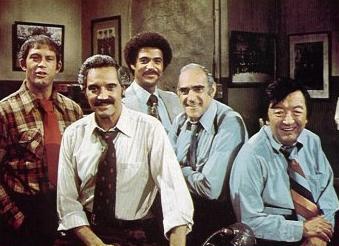
C&C is about great, sustainable coffee. Really crappy coffee, brewed daily by Det. Nick Yemana, played by Jack Soo (far right) was featured on the old TV show “Barney Miller.”  I was reminded of this during an email exchange with Counter Culture’s Mark Overbay, when I was remarking that I thought of this show whenever I poured a cup of hot coffee in my hot kitchen and went out to sit on my hot patio in the hot sun to drink it.  In one episode, Det. Fish wondered how Yemana could drink hot coffee during a heat wave.  I think Yemana justified it by saying something like, “It makes you sweat.”  This sent me on a search of coffee quotes from the show, and here are my favorites:

  • Yemana asks Barney if he would like some coffee, and a guy in the cell asks if he could have a cup, too. Barney: “This is a police station, not a coffee shop!” Yemana: “And we’ve got the coffee to prove it!”
  • Yemana offers coffee to a victim in distress. Woman: “Don’t you have anything stronger here?” Yemana: “There’s NOTHING stronger ANYWHERE!”
  • Yemana is taking a statement from a dignified older woman, and he gives her a cup of coffee. Yemana: “How’s the coffee?” Fancy woman: “It tastes like pencils.” Yemana: “That’s not the coffee…that’s the cup.”
  • Barney (holding “fresh” cup of coffee, with Yemana beside him holding the pot): “I would hesitate to call our coffee a crime. A shame, maybe. (Drinks) Oh…that’s a crime!”
  • A woman has just overdosed in the squadroom. Wojo gets off the phone with the paramedics and says, “They’ll be here in 10 minutes, but in the meantime we have to get her to empty her stomach. Yemana: “Yeah, I know. Give her some coffee”. Barney: “Just keep pouring it down her.” Wojo: “Two cups ought to do it.”
  • Yemana finally gets fed up with the comments about his coffee: “If you can’t say something good, don’t say anything at all.” The squad members each take a sip of their coffee, say nothing, and after a long period of silence, Yemana says, “Very funny!”
  • Somebody other than Yemana has made the coffee, and it tastes just as bad as it usually does. Yemana: “All these years…I thought it was me.”

Supposedly, Jack Soo’s last words to Hal Linden, who played Barney Miller, as he was being wheeled into the operating room before his death were, “It must have been the coffee.”

Research: Bat diversity in different types of shade coffee

Garcia Estrada, C., A. Damon, C. Sanchez Hernandez, L. Soto Pinto, and G. Ibarra Nunez.  2006.  Bat diversity in montane rainforest and shaded coffee under different management practices in southeastern Chiapas, Mexico.  Biological Conservation 132:351-361.

Southeastern Chiapas is Mexico's primary coffee-producing region.  Very little of the original montane rainforest remains.  Originally, coffee was grown under polyshade, or trees of various species found in the original forest.  Incentives have resulted in many farms using Inga trees for shade; these are native, hardy, fast-growing, deep-rooted, and fix nitrogen (however, production is not increased with Inga, there tend to be more weeds and soil erosion, so replacing forest with Inga doesn't offer many advantages).

This study looked at the diversity of bat species in shade coffee farms that use polyshade; or monoshade (Inga or Inga and bananas) with high, low, or no chemical inputs.  While unaltered montane rainforest had the highest number of species (37), all the others had 23-27 species.  Species composition was different, though, with more fruit and nectar eating bats found in farms with high chemical inputs, which had fewer insect-eating bats.  Application of pesticides decreases insect diversity for these species, especially insect families important to rare bat species. 

Coffee review: Intelligentsia Hacienda La Esmeralda Especial

Plainspoken Coffee. A Coffee Review for Ordinary People by Ordinary People, #5.

As promised in my previous backgrounder, a review of Hacienda la Esmeralda from Intelligentsia.

The beans: This was quite a light roast, just at city, medium brown with no oil on the beans.  They had a spicy odor that several of us immediately identified as smelling like pizza crust.  It was amazingly distinctive, and we thought that five of us coming up with the pizza analogy was remarkable.  Pizza crust is probably not an odor you’d want in your coffee, but rest assured, it did not taste like it smelled.  On day 2 post-roast, the freshly ground beans had a strongly floral smell, like a meadow in the hopper.  It faded quickly, and we couldn’t find it later.

Brewed: We tried this brewed in a drip on days 2 (gold filter) and 4 (unbleached paper) post-roast, and in a press on days 7 and 8.  We all agreed that the Ethiopian heritage was easy to distinguish, citrusy and very reminiscent of a Yirg.  In the press it was especially citrusy, with a mouthwatering juicy taste at first sip.

Several of us found it to be quite tea-like, in particular the aftertaste which was the most pleasant and non-coffee-like I’ve ever experienced, astringent like a good Darjeeling.  Kingfisher tasted cherries, and the Risky Kingbird could detect floral notes.  Overall, we were unable to pull out jasmine, green grape or apple, or some of the other exotic flavors experts found.  While we used a burr grinder and measured more carefully than usual, our pedestrian home gear and brewing style probably did not do this bean any favors.

We we blown away?  Not really, although some of us were pretty impressed. Star[bucks]ling thought this would be a coffee that could turn him on to a light roast. “This is the best cup of coffee I’ve ever had, but I don’t know why.” Coal Tit merely said “Whoa!”  She paused.  “That’s all I have to say.”

Other opinions: In the previous post I linked to reviews of earlier crops at bread coffee chocolate yoga; here is her take on this one.

Jim Schulman of Coffee Cuppers summarized the opinions at a tasting on one of the Coffee Geek forums:

“The Geisha had the across-the-room aromatics on Wednesday, but lost steam in the subsequent days.  The taste was sweet…with musky florals and cinnamon notes when warm, cooling to a spicey apple when cool. … In general the feel was that it tasted intermediate between a typical Central and an Ethiopian coffee; and that it would not have caused the same sort of sensation among tasters if it had been entered in the Ethiopian auction.

Is this worth the price of $50 green? In terms of absolute taste, probably yes. But there are other coffees in the same league…that sell for $8 to $12 at auction. After it’s performance and reputation in
the last two years, the bidders came ready to pay any price for this now legendary coffee, and the price reflects that, rather than its superiority to the other great coffees out there.”

Bottom line: No doubt, this was a lovely coffee, and in no way do we mean to dis it here. But for those of us without trained palates — and for the average, less-careful home consumer — it was nowhere as distinctive as the hype suggests.  We would not pay $30 a pound for it, much less $100.  We think, in fact, it would be a disservice to offer this coffee to a Maxwell House drinker with the idea of converting that person to quality coffee.  They would taste it and think it was great, but to an average joe, it would not be wildly removed and in a completely different class from what they were used to. We fear they’d think that if this was an example of the finest coffee in the world, there wasn’t a real need to change from commercial coffee. And that would be a shame.

Nonetheless, we are glad we tried this. With me, it averaged 3.75 motmots, but I was the stick in the mud with this coffee.  I just didn’t get into it.  So I will exclude myself from the scoring, which leaves it with a solid four motmots, with two people giving it over 4 motmots.

When to drink this coffee (field oriented): At the banquet when you are celebrating discovering a new species.

More on this coffee:

Interest percolating for rare cup of joe, Chicago Sun-Times.